
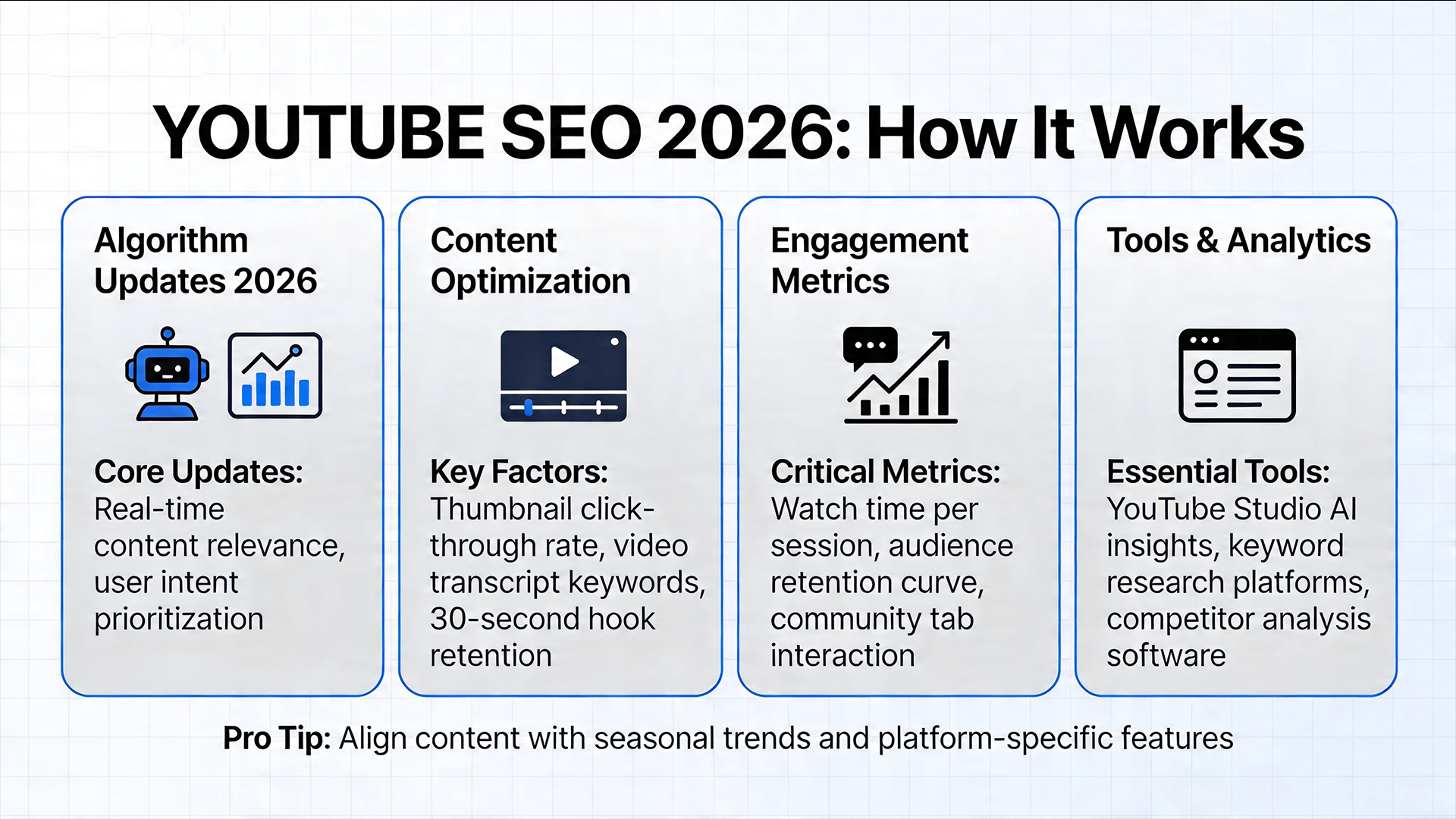
What Is YouTube SEO and How It Actually Works
Most people think it's about tags and titles. That's part of it. But that's not what actually makes videos rank.
Here's the thing nobody really tells you. YouTube doesn't rank videos based on what you write in the description. It ranks videos based on how people behave when they find them.
Think about two videos targeting the exact same keyword. One gets clicks but people leave after 10 seconds. The other gets fewer clicks but people actually watch the whole thing. The second one wins every time.
Keywords are just the starting point
Yes your title matters. It tells YouTube what your video is about and helps it show up in the right searches. But once someone sees it in results, the keyword has done its job. Everything after that is about behavior.
What most people focus on
Titles, tags, descriptions, uploading more videos and hoping something sticks.
What actually moves rankings
Click-through rate, watch time, retention, and how people interact after searching.
How YouTube actually decides to rank something
When you upload a video, YouTube doesn't just throw it onto page one. It shows it to a small group of people first, usually through search or suggested placements, and then watches what happens.
That's really it. The whole algorithm is basically just measuring whether people like what they find.
Why most videos never rank
It's usually not because the video is bad. It's because it never sends the right signals in the first place. No clicks means no test. No watch time means no push. The video just sits there and quietly dies.
Most videos don't fail because of the content. They fail because YouTube never had a reason to show them to more people.
The 3 signals that actually matter
If you want to understand YouTube SEO, these are the three things worth caring about.
- Click-through rate — if nobody clicks your thumbnail, nothing else matters. The video never even gets a chance.
- Watch time — if people click and leave in the first 20 seconds, YouTube reads that as a bad match and stops pushing it.
- Retention — people watching a high percentage of your video is one of the strongest ranking signals there is.
Why search traffic hits different
Not all traffic does the same thing for your video. Search traffic is powerful because the person is already looking for something specific. That intent makes them way more likely to actually watch, which means better signals, which means better rankings.
"The goal isn't to get views. It's to get the right views from the right search."
Where people go wrong
The most common mistake is just uploading and waiting. Or worse, sending traffic to a video that doesn't match the keyword it's trying to rank for. Random traffic from the wrong audience creates weak signals, and weak signals don't rank. YouTube sees people bouncing and pulls the video back.
The fix is matching your traffic to your keyword. When the people finding your video are actually searching for what it covers, the behavior signals are strong, and that's what gets you ranking.